
Posted on

Waterfall software development process

ZIPTRE 2

Brief History of Waterfall software development process

The Waterfall software development process was introduced by computer scientist Winston Royce in 1970. Royce first wrote about Waterfall in an article called, Managing the Development of Large Software Systems. Although Royce didn’t directly refer to his model as Waterfall, the article was actually about a process that was flawed for software development. Royce’s model allowed for more repetition between stages of the model, which Waterfall doesn’t allow you to do.
Royce’s actual model was more iterative in how it worked and allowed more room to maneuver between stages. We will discuss a more iterative way of working when we discuss Agile later on in the blog. Although Royce didn’t refer to his model as the Waterfall model directly, he is credited with the first description of what we refer to as the Waterfall model.
Royce’s original article consists of the following stages, which we’ll go into more detail on in a moment. Those stages are:
 Requirements Specification
 Detail Design
 Construction, where developers start crafting code
 Integration, where all the code is brought together and compiled into a run-able solution
 Testing and Debugging, where your testing will try to find defects that the developers
will fix
 Installation, where you deploy your system so that it can be used by your end users.
 Maintenance, where you fix any issues that are raised by the users.

How waterfall Process Works

The Waterfall process is split into separate stages, where the outcome of one stage is the input for the next stage. In the first stage, Requirements Specification, all possible requirements for the system to be developed are captured and documented in a requirement specification document. This document normally requires sign-off by key project and business stakeholders.
This part of the Waterfall model is typically organized by the business analysts, but depending on the size of your project, team, or organization, other members of your development team may be involved. This stage is about teasing out the requirements of the system from your stakeholders. This would include the required functionality, documentation of business rules and processes, and capturing any regulatory and compliance requirements that will affect the overall system


The next stage is System Design. The requirement specifications from the first stage are inspected, and the system design is put together. This design helps in specifying the system design requirements, and also helps with designing the overall system’s architecture. It is this stage where architects, solution designers, and developers will work together to decide how the overall system will be constructed. This is from a code perspective, and also a technology
choice and infrastructure perspective.

The next phase is Implementation. This is the phase where the developers take the design and start producing code to turn the design into a reality. The developers may also write automated unit and integration tests at this stage.
After the Implementation phase, we have the Integration and Testing phase. This is where all the deliverables from the implementation phase are brought together and tested as a whole.
The testing team should be working to a defined test plan. Once the system has been tested and signed off by the test team, the next stage is deploying the solution to your end users. Your end users may be internal customers within your organization, or customers.

Once the solution has been deployed, it goes into the Maintenance phase, where any issues that are reported will need fixing and re-deploying. This would generally be in the form of release patch fixes to your system. You may also perform small enhancements to the system at this phase. If an enhancement is quite large in scope, then you might start the Waterfall process again and start capturing further requirements.
All of these phases are cascaded, where progress is seen as flowing steadily downwards like a waterfall. The next phase is started only after a pre-defined set of goals are achieved from the previous phase. In this model, the phases do not overlap.
Posted on

History of Statistical Learning

ZIPTRE 2

Though the term statistical learning is fairly new, many of the concepts that underlie the field were developed long ago. At the beginning of the nineteenth century, Legendre and Gauss published papers on the method
of least squares, which implemented the earliest form of what is now known as linear regression. The approach was first successfully applied to problems in astronomy.

Linear regression is used for predicting quantitative values, such as an individual’s salary. In order to predict qualitative values, such as whether a patient survives or dies, or whether the stock market increases
or decreases, Fisher proposed linear discriminant analysis in 1936. In the 1940s, various authors put forth an alternative approach, logistic regression.

In the early 1970s, Nelder and Wedderburn coined the term generalized linear models for an entire class of statistical learning methods that include both linear and logistic regression as special cases.
By the end of the 1970s, many more techniques for learning from data were available. However, they were almost exclusively linear methods, because fitting non-linear relationships was computationally infeasible at the
time. By the 1980s, computing technology had finally improved sufficiently that non-linear methods were no longer computationally prohibitive. In mid 1980s Breiman, Friedman, Olshen and Stone introduced classification and
regression trees, and were among the first to demonstrate the power of a detailed practical implementation of a method, including cross-validation for model selection. Hastie and Tibshirani coined the term generalized additive
models in 1986 for a class of non-linear extensions to generalized linear models, and also provided a practical software implementation.
Since that time, inspired by the advent of machine learning and other disciplines, statistical learning has emerged as a new subfield in statistics, focused on supervised and unsupervised modeling and prediction. In recent
years, progress in statistical learning has been marked by the increasing availability of powerful and relatively user-friendly software, such as the popular and freely available R system. This has the potential to continue
the transformation of the field from a set of techniques used and developed by statisticians and computer scientists to an essential toolkit for a much broader community

Posted on

What is object-oriented programming?

oo

Object-oriented programming (OOP) is a programming paradigm that is based on the concept of objects, which can contain data and methods to manipulate that data. OOP is widely used in modern programming languages such as Java, C++, Python, and Ruby.

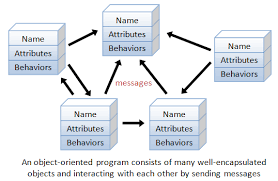
In OOP, programs are designed as collections of objects that interact with each other to perform tasks. Each object has its own set of properties and methods, which can be used to manipulate its data and perform operations on it. OOP is based on several key concepts, including encapsulation, inheritance, and polymorphism.

Encapsulation refers to the practice of hiding the internal details of an object from other parts of the program. This is achieved by defining the object’s properties and methods as private or protected, so that they cannot be accessed directly from outside the object.

Inheritance allows objects to inherit properties and methods from other objects. This allows for the creation of hierarchies of objects, where more specialized objects inherit from more general ones.

Polymorphism allows objects of different types to be treated as if they were the same type. This allows for more flexible and modular code, as different objects can be used interchangeably in the same program.

At Ankitcodinghub.co, we have a team of experts who specialize in object-oriented programming and can provide homework help in a variety of OOP languages. Our team is well-versed in the principles of OOP and can provide customized solutions to meet the specific needs of each student.

To illustrate our expertise in OOP, here are some coding examples:

In Java, we can create a class called “Person” that contains properties such as name, age, and address, as well as methods to set and get these properties:

public class Person {
  private String name;
  private int age;
  private String address;
  
  public void setName(String name) {
    this.name = name;
  }
  
  public String getName() {
    return name;
  }
  
  public void setAge(int age) {
    this.age = age;
  }
  
  public int getAge() {
    return age;
  }
  
  public void setAddress(String address) {
    this.address = address;
  }
  
  public String getAddress() {
    return address;
  }
}

In Python, we can create a class called “Rectangle” that contains properties such as width and height, as well as methods to calculate its area and perimeter:

class Rectangle:
  def __init__(self, width, height):
    self.width = width
    self.height = height
    
  def area(self):
    return self.width * self.height
    
  def perimeter(self):
    return 2 * (self.width + self.height)

In C++, we can create a class called “Vehicle” that contains properties such as make, model, and year, as well as methods to display its details:

class Vehicle {
  private:
    string make;
    string model;
    int year;
  
  public:
    Vehicle(string make, string model, int year) {
      this->make = make;
      this->model = model;
      this->year = year;
    }
  
    void display() {
      cout << "Make: " << make << endl;
      cout << "Model: " << model << endl;
      cout << "Year: " << year << endl;
    }
};

At Ankitcodinghub.co, we strive to provide the best homework help in object-oriented programming and other programming languages. With our expertise and customized solutions, we can help students achieve their academic goals and become proficient in programming.